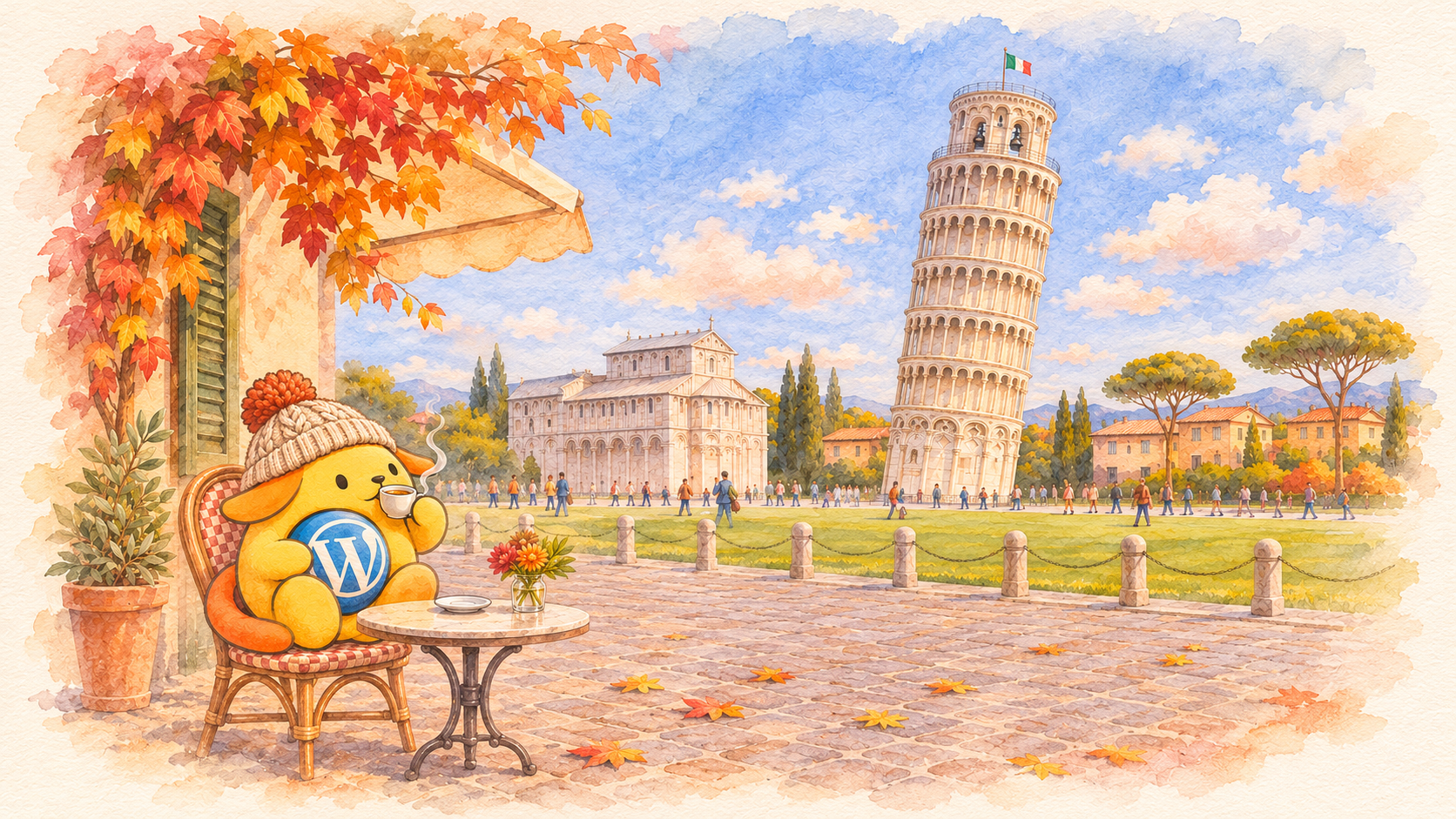
This year, I had the wonderful chance to be part of WordCamp Pisa 2026. It was my first time attending. I came to help with our sponsorship at the WordPress.com booth, but I also decided to join Contributor Day. I decided to take some time to reflect on these days.
Contributor Day

The contribution part of WordPress and the community is key to what makes WordPress so special and unique, both in the open source and commercial worlds. Truth is, I was greeted with such welcome and openness that it was beautiful to see and, more importantly, feel.
At Contributor Day, we had different tables, ranging from accessibility to core, polyglots, design, core AI, and plugins. I decided to join the core AI and plugins table lead by Marco Chiesi.
What made that table special was how we discussed the way AI is shaping the present we live in and the future we don’t know about. Nobody knows what the future will hold. We’re seeing how the landscape is changing for websites: building them from scratch is now possible thanks to the newest frontier models and people are excited about it. New waves of websites are appearing.
But what does that mean for services that rely on website management, for the plugin economy, or for the website and hosting economy? Nobody had an answer, but many of us had idea on what that means for the companies in this segment.
The group at that table was diverse, from people using websites for hobby projects to well-oiled companies providing support or working on WordPress. We debated, we discussed, but more importantly everyone there also tried to understand the other points of view, not just sticking to theirs.
Conversations at the WordPress.com Booth

The next day, I was at the WordPress.com booth with Luigi Teschio to help with questions about WordPress.com.
This was another first for me. What surprised me was the enthusiasm for WordPress Studio. Empowering developers to do their own thing, build their websites easily, export them, and play with AI resonated with people coming to the booth and we took our time to explain how Studio can help them build onto of WordPress while leveraging AI.
Besides this, what was valuable in these conversations was not really pitching a product or the company, but understanding how WordPress or the local development flow would fit into their lives. Where did they have issues with WordPress products or plugins, including official plugins? What can we do better as a company and as a community to sustain and support the future?
I’ve been reading recaps of WordCamp Pisa, and the future is the unknown we’re all looking at. Beyond pitching at the booth, we share the same questions: where will the market go, and how will it shift?
Nobody has the answer. But it was great to share opinions with everyone who passed by the booth and during the small chats we had while walking around WordCamp.
Challenging the Status Quo

We need to push forward. We need to challenge the status quo. We need to challenge our assumptions and what we think we should do or build.
We should have courage and believe in the power of the community to move WordPress and bring it into the future.
I’m a big believer in this, and it’s something I reiterated over these two days. So many commercial alternatives try to lock you into invisible CMSs and internal models where you cannot truly own your content. WordPress still stands as one of the giants that can protect the future and the people creating content, data, and applications.
It can make sure we have freedom: the freedom to change our content, the freedom to move our data elsewhere if we don’t like the place.
Democracy moves through WordPress, and now more than ever it’s time to protect that.
To close this, I think it’s important to remember that the magic behind every WordCamp is the community, their organizers, volunteers and speaker, thank you so much for making this possible.
Add your voice