Tag: life

  • Slop is Inevitable, Slop is Good

    Slop is Inevitable, Slop is Good

    More than 15 years ago, I decided I wanted to learn singing. Up until that point, I was the guy who didn’t sing. I didn’t sing in public, nor privately.
    We have this image of people singing in the shower. I didn’t sing in the shower.

    Singing was not part of my radar, it was invisible to me, it was a skill I never thought existed, although I could clearly see (and hear) singers. Admittedly, I didn’t listen to that many songs either, my musical culture was limited, but slowly improving as I was being contaminated by different genres.
    And yet, no singing.

    Until one day.
    I don’t know what prompted this need. It wasn’t because I aspired to be a singer, but one day I decided I’d learn how to sing.
    I searched for a teacher and found one in Florence and started taking lessons.

    It wasn’t cheap, and driving there required extra money, so for me this was also a considerable investment.
    But I made my choice, and I wanted to learn.

    I don’t remember how the first lesson was. I do remember some of them, but I know one thing: I was terrible.
    My voice was not precise, my rhythm was out of place.

    That was the beginning. I remember how learning to sing Landing in London (3 Doors Down) felt difficult, although the vocal line was straightforward compared to other genres and songs.

    Still, my voice felt cramped.
    And yet, I continued.

    Many years passed, and I kept slowly improving, but didn’t feel as though I was progressing. During that time, my taste for music changed, especially for voices. I would look for specific skills and abilities from singers because I was able to spot a good one from a bad one.

    I learned about the existence of vibrato. That kind of “bouncing” pulsation some singers were able to do either spontaneously or in a controlled way by moving their belly and their breath. (I didn’t like the singers who did the latter.)

    But I wasn’t good enough for that, and vibrato felt like something out of my reach.

    I continued studying and practicing. The vocal exercises meant that my entire condo would hear my voice practice, me singing various notes and trying to sing songs, often with a lot of passion (even with a lack of skill). I didn’t care, but I’m sure they might have preferred something else to that torture.

    I remember at one point I was about to drop out because I didn’t feel I was getting any good.
    Then two things happened.

    One night, I sang with some friends at a company party and some people actually did like my singing and honestly said they couldn’t believe I could improve that much (again, remember I was terrible in the beginning).

    That gave me confidence.
    But the true unlock was when, one day, I started producing vibrato. Spontaneously. I couldn’t control it initially, it was almost scary.
    And yet, from that day on, it became part of the skill set I had.

    My teacher said that it’s hard to know where we stand in our learning journey. We could be close to the next real unlock, but we’re not aware of it, and that unlock is not visible in front of us, plus we learn incrementally in small steps, so we don’t see this big shift from the inside.

    But from the outside, someone listening to me after years could spot a difference.

    Years later, I decided to learn improv.
    I remember some people were impatient because it was so hard to get good at it.
    The teacher said one thing that still stays with me today: “If you were good at it, you wouldn’t need to learn it.”

    Looking back at everything I’ve learned from scratch, I know that producing something that’s not good, or sloppy, is part of the process.
    Sloppy can be the way you learn. It doesn’t need to be that way forever, but it’s part of that continuous process of learning, self-correction, and evolution that every learning process contains.

    While I always wanted to be talented at singing, I wasn’t. I was determined, passionate, and intentional.
    Even though my results were messy, and my singing was torture in the beginning, that was enough. I was enough.

    That’s a reminder to me that, while it’s easy to be sloppy nowadays, as long as it’s part of a learning curve, as long as that sloppiness is an output of low quality and not an abdication of your work, all is good. You’re learning. You are enough. You will grow.
  • The Problem with Statistics and Averages: The Will Rogers Phenomenon

    The Problem with Statistics and Averages: The Will Rogers Phenomenon

    One of the problems with statistics and numbers is that we trust them as if they’re always trustworthy. But the problem with those numbers is that they depend on which domains and which sources they’re using. Averages are even trickier than that.

    One concept that blew my mind recently is the Will Rogers phenomenon.

    A Simple Example

    Let’s say you’re a sales manager.

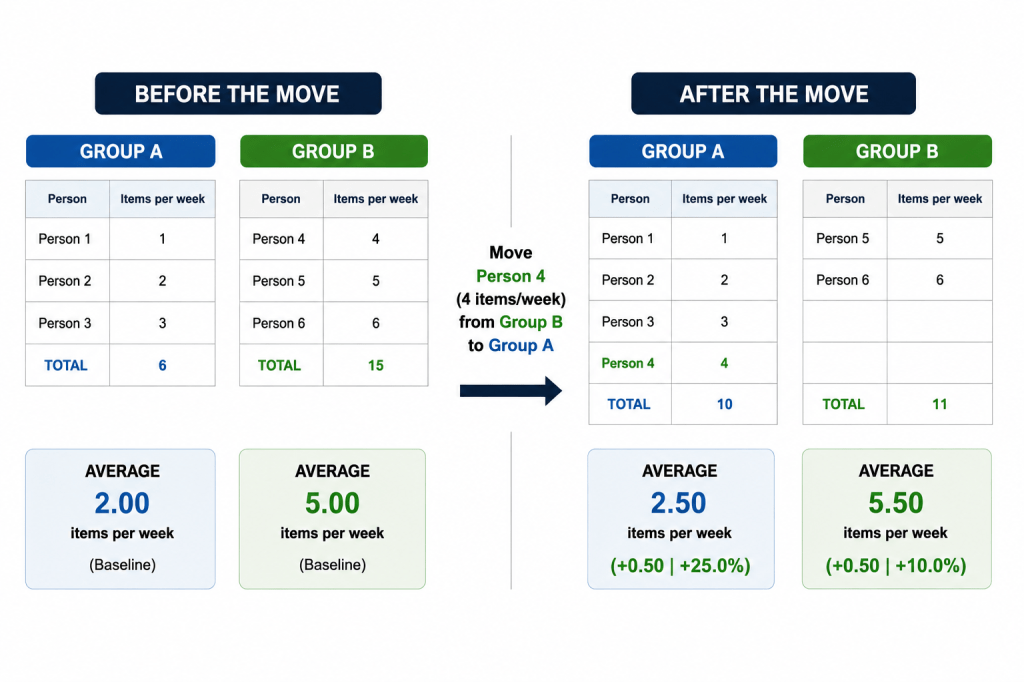
    You have two groups of salespeople.

    Group A

    • Person 1 sells 1 item per week.
    • Person 2 sells 2 items per week.
    • Person 3 sells 3 items per week.

    Group B

    • Person 4 sells 4 items per week.
    • Person 5 sells 5 items per week.
    • Person 6 sells 6 items per week.

    Now your boss comes to you and says, “Hey, you need to sell more items per week in both groups.”

    Here’s the interesting part.

    If you move Person 4 from Group B to Group A, you’re moving the lowest performer from the best-performing group into the least-performing group.

    What happens?

    Group A sees an increase in average performance because you’ve added someone who performs better than everyone already there.

    Group B also improves because it lost its lowest performer.

    Both group averages go up, even though nobody actually became better at selling.

    Numbers are tricky

    This example is obvious once you see it, but the same thing happens whenever you have two groups that are separated and you move lower performers from the better-performing group into the worse-performing one.

    That can happen intentionally, or it can happen unintentionally.

    One of the most controversial examples is around cancer.

    Stage 1 is the “entry level” group for when you’re diagnosed with cancer. The cancer is still early-stage and confined to the original site.

    The problem is that 50 years ago we didn’t have the same ability to detect cancer that we have today.

    Some cancers went unnoticed. Some of them probably weren’t even risky, so people simply continued living their lives with a normal life expectancy.

    Over time, though, technology evolved.

    Some of the people who previously belonged to the best-performing group, the people who lived a long and healthy life, are now included in the Stage 1 cancer group because we can detect those cancers today.

    Out of the blue, Stage 1 cancer group appears to have a higher life expectancy, even though there may have been no improvement in treatment, at least as far as this phenomenon is concerned.

    There may, of course, be genuine improvements in treatment, but that’s not the point.
    The point is that the average improved, even though nothing necessarily improved.

    Why? Because people moved between two groups, removing the lowest performers from the better-performing group and adding them to the worse-performing one.

    Every average and every statistic can be tricked.
    Treat numbers with caution, always.

  • It’s Never the Right Time, Yet It Always Is

    It’s Never the Right Time, Yet It Always Is

    How many times have you thought, “I’d really love to take this trip right now, but I have work, I can’t afford it.”

    Or, “I’d like to have a child, but my life is too messy right now, I wouldn’t know how to handle it.”

    When is the right time?

    When does that mysterious alignment of planets, events, things, and people happen, where everything is in its place and the only choice you have to make is handed to you by what we might call fate, ready to be seized?

    Does such a moment exist?

    A moment where we have the clarity to see that everything is perfect, that it is THE moment, and that only then should we make the choice we need to make: the trip, the children, changing jobs, changing lives, moving away, traveling, getting lost, starting over from scratch.

    I waited for many things in my life. I too waited for there to be a green light in front of the choices I wanted to make, but sometimes that green light never came.

    Just like with having children, I decided to have them even though I didn’t feel ready, even though life wasn’t as it was supposed to be, even though there was something that could have been done better.

    Looking back, I think: I did the right thing.

    The point is that there are two problems behind waiting.
    The first is that it’s not possible for there to be a green light.

    Life doesn’t make room for you; you make room for it.

    The world doesn’t adapt, it doesn’t know what you want. The world around you evolves in ways you cannot predict or imagine.
    So that astral conjunction you desire so much? Forget about it. It will never come.
    It will always be an imperfect choice, with an imperfect outcome, and yet still beautiful.

    The second point is that maybe there are cases where the world does prepare itself for you.

    Where the clearing’s leaves part to let you through
    In those moments, in the frenzy of today’s world, would we even be capable of seeing such a miracle?

    Or would our eyes quickly pass over those displaced leaves, ignoring them? Labeling them as something ordinary, when instead they were part of an immense design that we were incapable of seeing.

    So when is the right time?
    In the end, I think that if you’re asking yourself the question, maybe that is already the right time.

    Because ten years ago you wouldn’t even have asked yourself.
    It wasn’t on your radar.
    But now it is.

    Maybe you won’t be ready, maybe something will be missing, maybe you’ll make a mistake, but the point is that now you have a doubt you didn’t have before.
    And that doubt is the first spark, the first desire that writes in your heart what you want to do.

    You can ignore it and think that you need a whole world around you to justify it, but in reality that small glimmer, that doubt, so frightening and unfailingly beautiful, is enough to justify it.

  • We’re all (eventually) going to die

    We’re all (eventually) going to die

    I’ve heard a lot of stories in my life of people getting cancer. Some close to me, some more far away from me. And it feels as if it’s spreading.

    It’s scary to know that such a dark illness is somewhat common in the circle of the people I know. More common than I would ever have expected.

    It’s surprisingly sad. Because it’s a reminder that our time is limited on this planet and that really we’re all eventually going to die.

    Why is this happening?
    What did we do wrong?
    What are we doing wrong that allows cancer to spread?
    What are we ignoring?

    The reason I started thinking about this is because of one podcast episode from Lenny where they were saying that the concept of “when you lose, you learn something” is actually and we would be better of with “when you succeed, you learn something.”

    The reason behind this is that, when you lose, something was not okay, but you don’t really know what was that, whereas it’s easier when you are successful at something to pinpoint what worked and what didn’t. Therefore you have more information.
    The problem with learning through failure is that we don’t know where we’re failing, which leaves us clueless.

    That’s the way I feel when cancer hits close to home. Clueless. What do we have? What can we do? Where do we go?

    What’s even more heartbreaking is the realization that we’re here for a short amount of time and that whatever you did in life may matter or not. Obvious to some, but yet not something we are reminded daily.

    This crystalizes instantly to people when they realize the shortness of their life.
    Even more so when you’re younger, but equally true when you’re older, you think you’re going to live forever. Even if you don’t think about death, you think about it as if that is not an option, or it’s very distant in the future.
    But, actually, you (we) don’t know.

    That’s the beauty of life. We’re here for some moments to share some stories and pieces of the journey we’re in with other people. And it’s up to us to make sense of it, to have fun and to make it meaningful, to treat each moment as unique and precious.

    So wherever you are, whatever you do, remember you can always start over.
    You can try again.
    You can always try something new.
    You can let it go.
    You’re allowed to cry.
    And, more importantly, remember that love will still be around, no matter what.

  • Giving Your 100%

    Giving Your 100%

    Today I saw a recital from my kid. There were children of different ages playing different kinds of music and songs in this mid‑year experiment they did around music.

    What was interesting to me was watching how these kids approached the challenge, because each of them experienced it differently. You could easily spot the kids who were perfectly capable of doing the singing, the clapping, whatever was assigned, but who were bored because it wasn’t challenging enough. You could also see the ones slightly below the required capability, yet so passionate that they lit up the scene. And then there were the kids who didn’t believe in what they were doing and performed with no enthusiasm.

    What fascinated me most was how they looked when you watched them. The task was the same for everyone.
    Some were clearly more capable than others. Yet, from the outside, the kids who truly believed in what they were doing, who were passionate and put 100% of themselves,imperfections included, into the task, really shined.
    They stood out on a completely different level. You could also spot the ones who didn’t believe or trust what they were doing; their output was below average even though their skills were above average.

    While the results of those slightly below average in skill might not have been exceptional, their energy and passion made a difference. They were more entertaining, more interesting, more human than those who didn’t put in the effort.

    As adults, when we grow up, we tend to step back. We hold ourselves back from fully expressing ourselves. We push less, show up less, and sometimes do the bare minimum.
    We may have similar reasons, but one common issue,at least for me, is the fear of being judged as stupid, overly enthusiastic, or out of place. Yet that’s exactly what’s valuable: seeing differences, seeing passion, seeing what each of us brings with our unique capabilities, skills, emotions, feelings, and the knowledge we’ve gained through life.

    It’s perfectly reasonable to say, “This doesn’t interest me; I don’t want to put my 100% into it,” whether at work or in life. That’s fine.

    But if something is valuable to you and you’re still not showing up fully, it’s reasonable to ask yourself why. Is it not motivating, not interesting, not challenging, not fulfilling? Do you not believe in the mission? Whatever the reason, build awareness around what’s valuable and what you need to get to the point where you’re not just on stage doing the bare minimum to pass the test, but showing what you’ve got and believing in it.

    Every time I think about this, a post from Derek Sivers comes to mind about followers. In the post, you see a person dancing with full energy.
    At one point someone joins, and then it becomes a movement. You need both the follower and the leader, but both of them must give 100% to the world, to fully work and build a movement.

    It’s not important who you are in that story.
    What matters is understanding what drives you and what might be holding you back from giving your full 100%.

  • Nature and us

    Nature and us

    It’s hard to put into words how beautiful nature is, even harder to describe what you get by being immersed into nature.

    I think it’s even more amplified when you don’t have any choice but to surrender to it, when the cellular connection is not working, when there’s nobody to talk to, and you don’t have anything else to do.

    In those moments, locked into nature, you’re only left with that old need to just enjoy the moment, to live through those boring and seemingly useless minutes and hear/see/smell life itself through nature.

    Couple of years ago I did a family trip to a place I knew very well, close to home. It’s in the mountains, the cellular connection is unstable and there are some small walkable paths in the forests. Some are easier, some are harder.

    We intentionally chose a time when there would be almost no one walking around.
    The cool thing about traveling to somewhere where you already know everything about the place is that you don’t need a schedule.

    You wake up and figure out the day. You can walk around, do some light trail walking, or just chill.
    There is no need to do something, plus having the smartphone hardly usable made it even more valuable to me as I was enjoying those boring times when I had nothing to do but wait.

    And yet, and still, there’s something that fascinates me from the contrast I feel from how, as humans, we build stuff in nature. Even more so when I’m standing alone in front of them.

    The photo from this post was taken in one of those moments, coming back from a walk with my family, and the 5G towers were standing silently in front of me, at the top of the hill.

    Looking at that photo now, I can’t help but thinking back to the “Electric State” book, from Simon Stålenhag, but with less robots.

  • The space between things

    The space between things

    The waiting in front of the traffic light, looking at the motionless pedestrian stripes that await our steps.

    The void before our turn comes at the post office, between one number and the next. In the silence amidst a thousand different voices, each with its own thoughts and its life that rushes away like a swollen river.

    Today, these waits seem heavier than ever, as if the space between them has become unbearable, as if waiting were a problem. As if the void, which has always existed, is now an uncomfortable housemate, one we neither want to see nor hear.

    Everything must happen immediately. And if it doesn’t happen, we absolutely must have something to do, to act, to get something in return: endorphins, joy, sadness, excitement. That void cannot just be empty, it must have a purpose or satisfy us.
    As if we were in control of a direction, even when the direction of what we see and listen to, of videos of strangers on the other side of the world, depends on others, on algorithms shaped by our hunger, algorithms that mimic the color of our desires.

    What is it about that void that scares us? Of that silence that welcomes us when we are alone where the world moves around us, with people walking, talking, thinking, and acting, each with another world, a broken heart, a fear of being seen and accepted, with a scream hidden under the skin that just wants a hug but in the end it’s easier to scroll past another raw news story, another funny reel, another exciting photo.

    To be elsewhere so the void doesn’t exist, so that the moment where we are entirely alone, with ourselves, forced to be in the world, is annihilated. And everything becomes a continuous flow, a Panta Rei but without awareness of it, without presence, flowing cuddled by a river we did not choose, watching a sky whose colors we do not recognize.

    I don’t know if this applies to everyone. I know that sometimes, in that void and in that silence, I am afraid of feeling everything.
    All the complexity of the world and of my feelings, which overflow and blur together, preventing me from understanding what is happening. Hate, joy, fear, emotion, affection, loneliness, their borders disappear and become a loud, powerful orchestra whose sound speaks to me from the depths, but whose words I do not comprehend.

    And the temptation to scroll again is always strong, the temptation to lower my head and look at another story, read another news item, watch another video. To lose myself, to not feel, to not listen, to not be there, in that moment.

    And yet, I remember.

    I remember myself, waiting on the rough sofa of the house, and the scent of the schiacciata in the oven taking shape and flavour with the oil, and how sweet that wait was.

    I remember waiting for a friend’s visit, and how that void was full of infinite energy and emotion, of trepidation and anxiety.

    I remember watching the streetlights on winter evenings, with my breath fogging the glass, watching the car lights as if I could distinguish those of my mother’s car, and waiting, counting them, and then running to hug her and smelling the fresh scent of winter mixed with the smell of smoke on her long, dark coat.

    Since when did these voids lost the emotions that accompany every wait? The trepidation for what will happen, that potential energy that reminds us that anything can still happen and that the void is just the prelude to another, beautiful, new beginning?

    The space between things is still the same. The void and its molecules have not changed. But we… we did.

    (this is the translated version of my original Italian post)

  • Letting go of perfection: Just write

    Letting go of perfection: Just write

    One of the things I realized while trying to publish more is that things often get in the way, and every time, there is a new obstacle. This is true for many goals we set in life. But why is that?
    In this post, I want to make the case for why you should try to publish more, and why you should pay less attention to your own doubts.

    For example, when I start writing something, I notice that there’s a new design I could use, or there are some theme improvements I could make to my blog. Sometimes, I realize that a specific topic might be outdated in a couple of months, and I keep asking myself: Is it still worth writing?
    Should I write about this? Then, there’s the judgment—wondering if it’s even worth it, or if people already know about it.

    In a world increasingly filled with AI-generated content, I believe it makes more sense than ever to publish and share what only a human can.
    What can we do to express our thoughts and ideas?
    Remember: our perspectives are truly unique. These are the qualities that make humanity so fascinating.

    For example, if you think again about “Should I write this?” you see that there will always—or at least often—be someone who wanted to hear what you had to say but never could, or someone who agreed with your thoughts or could learn from you.
    I’ve seen this happen repeatedly, both in my own experience and with friends. We take our thoughts and ideas for granted, but we should share them more because the world needs ideas, connection, and human voices.

    In an ever-more-connected world, this is what makes us unique and irreplaceable: that connection and shared understanding, those ideas we try to spread, and the way we see the world.
    Those are the reasons that make you, well, you.

    One thing that improved my writing was consistency.
    Lately, I’ve been enjoying the process of using dictation, and some tools with extra features that help me write as I speak.
    You may find you have plenty of ideas but aren’t good on writing.
    Dictation tools like MacWhisper or WisprFlow have come a long way. If you connect them to AI tools, they can clean up the words and further refine your contents, without losing your voice..

    So, whenever you find yourself wondering, “Should I write about this?” I would argue: yes, please do.
    Just focus on the writing; don’t worry about the rest.

    Distracted? Go back to writing or consider dictation as I mentioned.
    Want to change your blog design? Write instead.
    Yes, eventually you might want to improve the design, but writing is the thing you want to eventually do, so do that. Don’t work around it, don’t procrastinate. Just write.

    And in case you feel you have yet to learn how to write well or you are scared about how people will judge your writing then have a separate blog, no comments, where you write daily or very frequently.
    Small phrases, long stories, whatever works for you.
    As with many of our skills, writing takes time, and the only person that can put that time in is you.

  • Why did I start Working Part-Time instead of Full-Time and the Benefits of a 4 Days Workweek

    Why did I start Working Part-Time instead of Full-Time and the Benefits of a 4 Days Workweek

    Around august 2015 I decided that I wanted to step back from my 9-5 job and work part-time for the same company and it was one of the best decisions of my life.
    In this post I want to highlight the story, the tradeoff, the benefits and the downsides of this choice to help everyone that is uncertain about it have a better understanding of what might happen.

    But let me rewind for a second. (more…)